
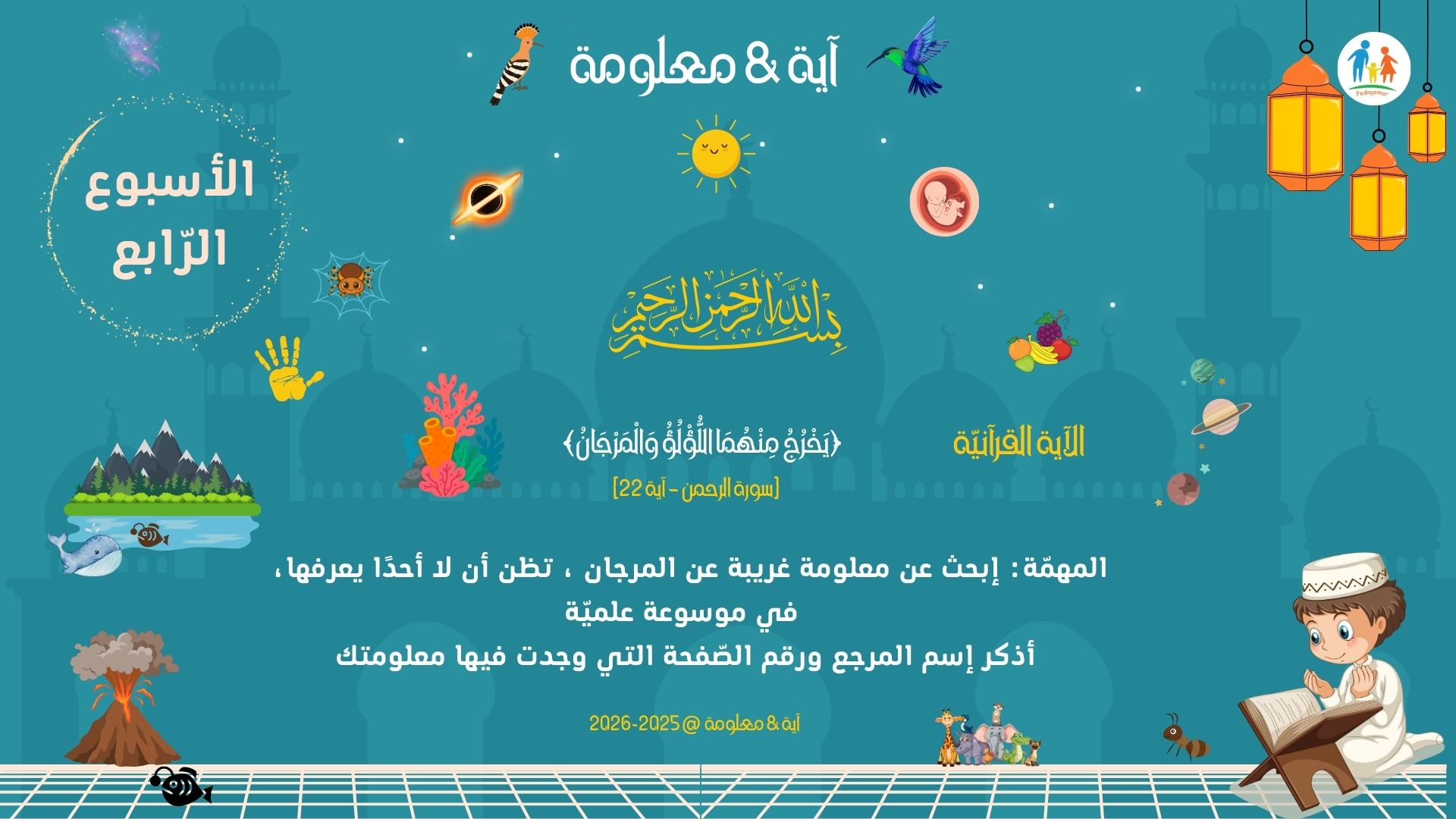
Educational objectives for reflection and contemplation on the Noble Verse
In the Name of Allah, the Most Gracious, the Most Merciful
“From both of them emerge the pearl and the coral.”
True are the words of Allah, the Most High
— Surah Ar-Rahman, Verse 22
1. Divine Creativity in Creation
The child reflects on the greatness of God’s creation by discovering that coral and sea anemones are not plants, but animals shaped by God with stunning colors and fascinating forms.
The child learns how coral builds underwater “cities” called coral reefs, and how sea anemones move slowly and use their tentacles to catch food.
He/she connects this creativity and the precise organization of the ocean to God’s absolute power:
“This is the work of Allah, Who perfected all things.”
2. Divine Mercy
The child understands that God created relationships of cooperation and mercy among sea creatures, such as the relationship between the clownfish (“Nemo”) and the sea anemone:
one provides protection… the other provides food and cleaning.
The child observes God’s mercy in making coral reefs a safe home for thousands of marine creatures, protecting them from predators and providing sustenance.
He/she learns that God’s mercy embraces all creatures—on land and at sea, big or small.
3. Gratitude
The child learns to thank God for the beauty of the sea, the diversity of its creatures, and the hidden blessings that sustain life on earth.
He/she feels grateful knowing that God created a perfectly balanced system in the oceans, where every creature has a role and a function.
The child discovers that the ocean is not a random mix of creatures, but a precisely organized world created by God.
Every creature—even the smallest coral or the gentlest anemone—has a mission that helps maintain life.
-
Coral builds homes for marine animals.
-
Fish clean the coral.
-
Sea anemones protect the fish… and the fish bring them food.
-
Algae produce the oxygen that humans breathe!
All of this shows that God created an interconnected web of life.
Why is this objective important for the child’s life?
1️⃣ Because the balance of the ocean preserves the balance of the entire Earth
Coral reefs help filter water and produce oxygen, directly affecting the air we breathe.
2️⃣ Because it teaches the child that every creature was created with wisdom
By realizing that even the smallest being has a function, the child grows respectful of all creatures and aware of the importance of protecting the environment.
3️⃣ Because gratitude helps the child notice hidden blessings
Even if the child does not see the sea every day, he/she benefits from many blessings:
-
cleaner air
-
food for humans and animals
-
climate regulation
-
uplifting beauty
The child learns to thank God even for blessings that are not immediately visible.
4️⃣ Because it builds environmental responsibility
Understanding that every creature has a role, the child realizes that throwing trash in the sea or destroying reefs harms this delicate balance.
He/she grows into an environmental guardian, not just a consumer.
5️⃣ Because gratitude deepens faith
Seeing the precision of God’s design in the ocean brings the child closer to God, increasing awe and reverence. Gratitude becomes a natural part of daily life.
The child expresses gratitude by saying:
“Praise be to God who created the sea and its wonders, and taught me to reflect on His blessings.”
Practical Activity – “Which one is the animal?”
Objective: to recognize that coral and sea anemones are animals created by God.
-
Show children pictures of a plant, coral, sea anemone, fish, and a rock.
-
Ask them to classify: Animal – Plant – Non-living.
-
They will be surprised! Many will classify coral and anemones as plants.
-
Conclude with the message:
“God created creatures that don’t always look like what we expect. That’s why we observe, learn, and glorify God for the wonder of His creation.”