
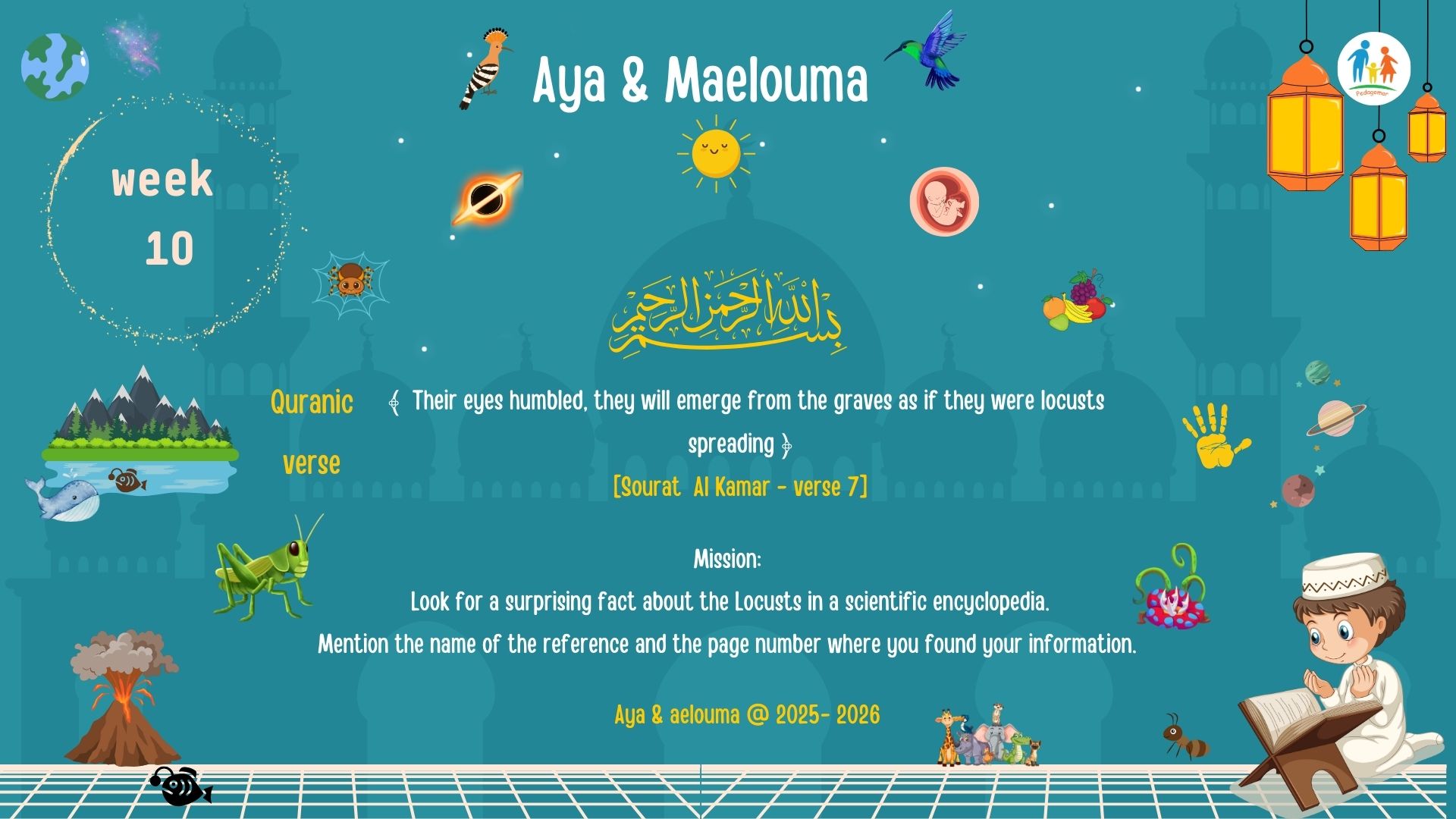
Verse of the Week – Aya & Ma‘louma Program
Allah, the Exalted, says:
“With humbled eyes, they will come forth from the graves as if they were scattered locusts”
(Surah Al-Qamar, verse 7)
Contemplative Educational Objectives for Children
Aya & Ma‘louma Program – Topic: Locusts
Divine creativity in creation
- The child reflects on how God created the locust with precise features:
- Strong wings that allow it to fly long distances.
- Legs adapted for jumping and fast movement.
- An ability to adapt to different environments.
- The child understands that every creature has a unique design and a wisdom behind its creation, no matter how small or simple it may seem.
God’s laws in the universe and ecological balance
- The child learns that locusts usually live individually, but can transform into huge swarms when environmental conditions change.
- The child reflects on how changes in nature follow laws set by God, and that every phenomenon has a cause and an order.
The power of community and organization
- The child observes how locusts move in organized swarms, like a well-coordinated army.
- The child learns that cooperation and organization bring strength, and that collective action can be a blessing or a trial depending on how it is used.
Mercy and warning at the same time
- The child reflects on how locusts can be:
- A source of food for some peoples.
- A trial when they destroy crops.
- The child understands that some creatures carry warning messages for humanity, calling people to return to God and improve their behavior.
Reflection instead of fear
- The child learns not to look at locusts only with fear, but with reflection:
- Why did God create them?
- What do they teach us about nature?
- The child develops scientific curiosity connected to faith rather than fear.
Gratitude for blessings
- When the child sees the damage locusts can cause to crops, they learn to thank God for the blessing of food and stability.
- The child connects reflection on living creatures with a sense of gratitude for what they have.
Activity of the Week:
The Locust… a Small Creature with a Big Message
The children sit in a circle. The educator reads the verse calmly, then asks the children to close their eyes and imagine locusts scattered across the sky.
Oral question:
What did you imagine when you heard the verse?
Simplified scientific discovery
The educator shows a picture or a short video of a locust, then explains in simple language:
- How does it jump?
- How does it fly?
- Why does it sometimes live alone and sometimes in swarms?
Connection:
This organization and precision… who created them?
Guided reflection
The children are given a sheet with a drawing of a locust (or they draw it themselves).
✏️ They are asked to write or say a reflective sentence:
- For younger children (ages 6–8):
What I like about the locust is… - For older children (ages 9–12):
I see God’s creativity in the locust because…
Mercy and gratitude
Simple discussion:
- Locusts can eat crops → how does that make us feel?
- What do we learn when we see this?
Gratitude exercise:
Each child says a sentence that begins with:
“Alhamdulillah for the blessing of…”
(food – water – safety – nature…)
The creature’s message
The children are asked:
If the locust could speak, what would it remind us of?
The child writes or says: The locust teaches me that…
Educational takeaway
- The locust is not frightening; it is a sign.
- Its creation reflects divine creativity.
- Reflecting on it invites mercy and gratitude.